
In Dubai, a city synonymous with vertiginous skyscrapers and futuristic ambition, the traditional souks of Deira offer a vivid counterpoint—a sensory plunge into the emirate’s storied past. These bustling marketplaces, nestled along the banks of Duba...
At the base of the Burj Khalifa, the Dubai Fountain performs a daily spectacle that blends art and engineering. Spanning 275 meters—longer than two football fields—this $218 million fountain, designed by WET Design, shoots water up to 150 meters high, synchronized to music ranging from Arabic classics to global hits like Thriller. Since its debut in 2009, it has drawn millions, offering free evening shows every 30 minutes.
The fountain’s 6,600 lights and 25 projectors create a kaleidoscope of colors, while 83,000 liters of water dance in patterns programmed by a team of choreographers. Its mechanics are staggering: 22,000 gallons of water are airborne at any moment, propelled by high-pressure nozzles. Maintenance divers regularly inspect its underwater systems, ensuring flawless performances.
The fountain’s magic lies in its ability to pause Dubai’s frenetic pace, uniting strangers in shared awe. It’s a fleeting reminder that beauty, even when engineered, can feel transcendent.
Photo credits: burjkhalifa.ae
Alexander Agafiev Macambira
Alexander Agafiev Macambira is former tech contributing writer for Forbes Monaco.

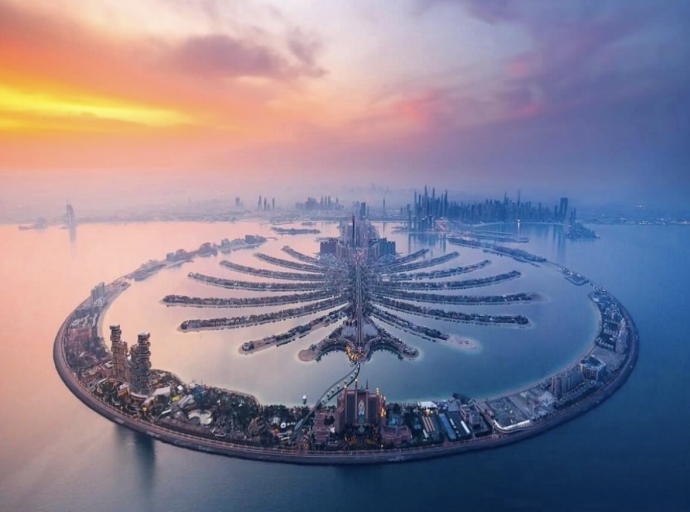
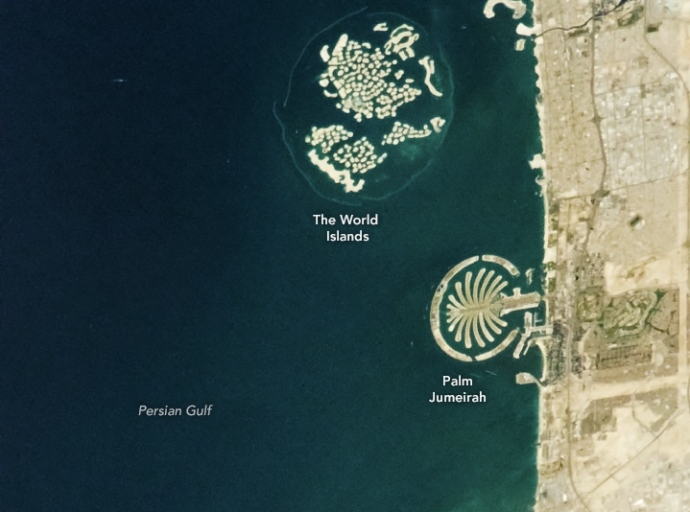
From space, the Palm Jumeirah looks like a tree sprouting from Dubai’s coastline, its 17 fronds and crescent-shaped breakwater forming a man-made archipelago. Completed in 2008, this $12 billion project added 78 kilometers of shoreline, hosting luxury hotels like Atlantis, The Palm, and private villas that attract the world’s wealthy.
The Palm’s creation was a marvel of marine engineering. Over 94 million cubic meters of sand were dredged from the Arabian Gulf and sprayed into place using GPS-guided vessels. A 11-kilometer breakwater, built with 7 million tons of rock, protects the island from waves. Yet, environmental concerns linger: studies suggest the project disrupted local marine ecosystems, though Dubai has since invested in artificial reefs to mitigate damage.
Visitors can explore the Palm via a monorail connecting the mainland to Atlantis, where a waterpark and aquarium draw families. Strolling the Boardwalk along the crescent offers views of Dubai’s skyline and the Gulf’s turquoise waters. The Palm Jumeirah embodies Dubai’s knack for turning improbable visions into reality, inviting travelers to ponder the line between innovation and excess.
Photo credits: Wikipedia.
Alexander Agafiev Macambira

Alexander Agafiev Macambira is former tech contributing writer for Forbes Monaco.
In Dubai, ambition takes physical form in the Burj Khalifa, the world’s tallest building at 829.8 meters. Completed in 2010, this steel-and-glass spire, designed by Adrian Smith of Skidmore, Owings & Merrill, redefined what a skyscraper could be. Its Y-shaped base, inspired by the desert flower Hymenocallis, anchors it against the region’s fierce winds, while its central core houses 57 elevators whisking visitors to the 148th-floor observation deck in under a minute.
The Burj Khalifa is more than a feat of engineering; it’s a symbol of Dubai’s relentless drive to transcend its origins as a modest trading port. Named after the president of the United Arab Emirates, Sheikh Khalifa bin Zayed Al Nahyan, it was built at a cost of $1.5 billion, employing over 12,000 workers from across the globe.
For visitors, the Burj Khalifa offers breathtaking views, especially at sunset when the desert horizon glows. Tickets to the 148th floor cost around $100, but booking early online saves time and money. Nearby, the Dubai Mall, with its 1,200 shops, provides a grounding contrast to the tower’s ethereal heights. To visit is to witness a city that dares to dream vertically, even as it grapples with its earthly challenges.
Photo credits: Burj Khalifa Instagram.
Alexander Agafiev Macambira
Alexander Agafiev Macambira is former tech contributing writer for Forbes Monaco.
Jumeirah Marsa Al Arab, Dubai’s 2025 hotspot, hosts The Cullinan, a sophisticated steakhouse that has quickly become a must-visit. Designed by architect Tristan du Plessis, its interiors marry gleaming marble with antique golds and olive leather, while the Burj Al Arab-facing terrace offers white-clothed tables under whimsical, animal-printed umbrellas.
Perched on the 122nd floor of the Burj Khalifa, At.mosphere is the world’s highest restaurant, offering French-European cuisine with panoramic views of Dubai’s skyline and the Arabian Gulf. In 2025, it remains a Michelin-starred icon, blending opulence with culinary finesse under chef Nicolas De Visch.
The degustation menu, starting at 880 AED, showcases dishes like langoustine royale and tarte tatin, crafted with premium ingredients. The art-deco interiors, featuring jewel-toned wallpaper and mirrored staircases, evoke timeless luxury. Afternoon tea, accompanied by live violin and piano, is a decadent ritual, with delicate sandwiches and champagne.
Despite its lofty price and formal dress code, At.mosphere’s allure lies in its unmatched setting. The view - glittering skyscrapers by day, a neon tapestry by night - makes it a favorite for celebrations. Booking well in advance is essential, as tables by the floor-to-ceiling windows are highly sought after. At.mosphere is Dubai dining at its most iconic.
Photo credits: Atmospheredubai Instagram.
Alexander Agafiev Macambira
Alexander Agafiev Macambira is former tech contributing writer for Forbes Monaco.
Ossiano, nestled in Atlantis, The Palm, offers one of Dubai’s most surreal dining experiences: a Michelin-starred seafood journey surrounded by floor-to-ceiling aquarium views. Sharks, rays, and tropical fish glide past as diners savor chef Grégoire Berger’s ocean-inspired tasting menu, priced between 1,095 and 2,100 AED.
The 2025 menu features dishes like Norwegian langoustine with delicate herb emulsions and “Snacks of the Sea,” a playful medley of marine flavors. The underwater setting, described by reviewers as “otherworldly,” enhances every bite. In 2024, Ossiano ranked third on MENA’s 50 Best Restaurants list, lauded for its artistry and ambiance.
The restaurant’s exclusivity - reservations are fiercely competitive - and its steep price point reflect Dubai’s appetite for spectacle. Yet, the seamless service and innovative cuisine ensure it’s more than a gimmick. For those seeking a bucket-list meal, Ossiano delivers a sensory immersion unmatched in the emirate.
In the heart of Dubai’s St. Regis Gardens, Trèsind Studio has redefined Indian cuisine with a historic achievement: in May 2025, it became the world’s first three-Michelin-starred Indian restaurant, as announced by the Michelin Guide. Helmed by chef Himanshu Saini, this intimate 20-seat venue offers a 16-course tasting menu that traverses India’s regional flavors with modernist precision.
The Lana, opened in 2024 by the Dorchester Collection, sits along Marasi Bay Marina, offering serene views of the Burj Khalifa. Designed by Foster + Partners, its 225 rooms and suites, starting at 50 square meters, embrace understated elegance with pale rose velvet, pink leather, and mosaic columns. The rooftop infinity pool is a highlight, reflecting Dubai’s skyline at dusk.
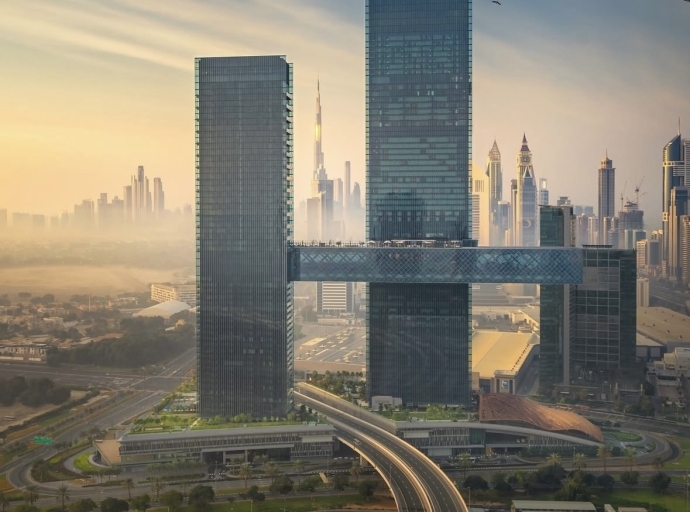
Opened in 2024, One&Only One Za’abeel is Dubai’s first “vertical resort,” housed in a striking dual-tower structure linked by The Link, a 230-meter cantilevered boulevard. Located in Za’abeel, near Downtown Dubai, its 229 rooms and suites, starting at 65 square meters, feature glass walls with Burj Khalifa views. Grand suites include separate dressing rooms and standalone tubs.
Atlantis The Palm, opened in 2008 on the crescent of Palm Jumeirah, is a 1,539-room ocean-themed resort. Its 46-hectare site blends luxury with family-friendly adventure, anchored by the Aquaventure Waterpark, the world’s largest with 105 slides. The Lost Chambers Aquarium, home to 65,000 marine animals, offers underwater views in select suites.
Perched on an artificial island off Jumeirah Beach, the Burj Al Arab Jumeirah, opened in 1999, redefined luxury hospitality. Its sail-shaped silhouette, stretching 321 meters, is a global symbol of Dubai’s opulence. The hotel’s 198 duplex suites, starting at 170 square meters, feature gold-leaf accents, Hermès toiletries, and 24-hour butler service.
Dubai, long synonymous with extravagance and architectural marvels, is now redefining luxury through a new lens: wellness. The emirate is swiftly evolving into a global hub where sophisticated self-care meets world-class hospitality, appealing to discerning travelers seeking holistic rejuvenation.
In a region long defined by its arid climate and rapid urban growth, Dubai is emerging as a global exemplar of sustainable development. Central to this transformation is the ambitious Dubai Clean Energy Strategy 2050, which aims to produce 75% of the emirate’s energy from clean sources by mid-century. This bold vision reflects Dubai’s commitment not only to economic diversification but also to environmental stewardship.
At the heart of this green revolution is the Mohammed bin Rashid Al Maktoum Solar Park, currently the largest single-site solar park worldwide. Set to reach a capacity of 5,000 megawatts by 2030, the solar park embodies the city’s transition from fossil fuels toward renewable energy. This massive infrastructure project promises to reduce carbon emissions and serve as a model for clean energy projects across the globe.
Dubai’s sustainability efforts extend beyond energy production. The city’s Sustainable City, the Middle East’s first fully operational eco-city, showcases how urban living can be both luxurious and environmentally responsible. With zero-net energy homes, extensive urban farming, and car-free zones, this community redefines modern city life by integrating green technology with social wellbeing.
Further reinforcing these initiatives are Dubai’s Green Building Regulations, introduced in 2014. These regulations mandate that all new developments comply with stringent energy and water efficiency standards, ensuring that sustainability is embedded in the city’s rapid urban expansion.
Dubai’s green economy trajectory reflects a larger global shift toward sustainability. By turning its desert landscape into a hub of renewable energy and eco-conscious living, Dubai is not only addressing climate challenges but also setting a new standard for sustainable urban growth in the 21st century.
Photo credits: dewa.gov.ae. Mohammed bin Rashid Al Maktoum Solar Park.
Alexander Agafiev Macambira
Alexander Agafiev Macambira is former tech contributing writer for Forbes Monaco.